Monday, April 9, 2012

MODULE VIII - LINKS

ESSENTIAL QUESTION:
The conduct of war presents incredible challenges as well as opportunities.  These impact the economy of the country as well a the daily lives of all participants.  Describe the challenges and opportunities unique to Alaska during World War II.

First Photos of Our Attack on Attu, 
May 11, 1943
VILDA  UAF-1970-11-32
The challenges and opportunities unique to Alaska
 during WWII were mostly contributed to the 
geographical location of Alaska. The country was                 
taken by surprise by the attack on Pearl Harbor, 
December 7, 1941. The military scrambled to take
measures to protect the northern pacific waters and 
lands from Japanese invasion. 
 
Native Alaskans were evacuated from their homes 
and taken to a different place supposedly for protection,
(this is expanded on in my examine question),
the huge challenge of building a road that linked
Alaska to the lower 48 was constructed. This involved
employing many people, both native to Alaska and 
military personnel. Many Alaska Natives volunteered 
    their time in dedication to protecting their country. 

ATG Being Sworn In, Barrow
VILDA UAF-1976-21-587

 THESE BOYS COULD SHOOT!!                                               Alaska Territorial Guard

ATG Patch
VILDA UAF-1972-182-1


The military presence in Alaska grew during WWII and 
remains today. After WWII, it became evident that Alaska
needed to gain statehood. This opened many doors for
Alaskans.  One of those open doors was impetus to a Native
Civil Rights Movement. 


Anchorage Daily Times Headline 7/1/58
After Congress Passed Statehood Act
VILDA UAF-2006-154-8


EXAMINE:                           

Describe the major events in the Aleutian Campaign of World War II.            

The most tragic of events in the Aleutian Campaign of WWII was the
evacuation and internment of the Aleuts.  This even occurred after Attu 
and Kiska were invaded by the Japanese. This evacuation was a 
strategy to keep the natives safe. Their homes, schools, and churches
were destroyed so the "Japs" could not benefit from them.   

"In 1942, my wife and our four children were whipped away from our home... all our possessions were left... for mother nature to destroy.... I tried to pretend it was really a dream and this could not happen to me and my dear family."
-Bill Tcheripanoff, Sr., of Akutan
The Aleuts were taken from their home to Southeast Alaska. They were
not used to trees, constant rain, sickness like pneumonia and tuberculosis
overtook them. They were provided little provisions of food.
They were not given any guns to hunt with. Germans in P.O.W. camps
were treated better then these people who were Alaska Natives.

The Japanese bombed Dutch Harbor six months after the bombing
of Pearl Harbor. They invaded the islands of Attu and Kiska. The
United States took back the islands but not without casualties. The
Japanese suffered the most casualties.

EVALUATION:
Wow! Another great module. I learned a great deal of information. 
Another layer of Alaska exposed and what makes this place such
a great place to be. I also found it interesting about the quonsets that
were left behind by the military. I was taking a drive and I came upon
a business called the Blue Loon. It is housed in a quonset. I wonder if
this is one of the quonsets left behind? 


Tuesday, March 27, 2012

MODULE VII - THE LAST FRONTIER!

HAPPY SEWARD'S DAY!!

ESSENTIAL QUESTION:
    How have the settlement patterns of Alaska been a reflection of the natural landscape, distance, resources, and the economy?
  •   Natural Landscape  
Tundra
 Settlement patterns of Alaska have been a reflection 
of the natural landscape as pioneers initially settled
 along the coast and rivers due to accessibility of the
 waterways. Roads and railroads have been limited because
 of the challenges of building on 
tundra, permafrost, muskeg, and around mountains
Settling and traveling in Alaska has been a little more involved than "over the river and through the woods..." 


Wetland
The two pictures at the left are from the same area in Alaska.                                                       
     Permafrost degradation on the Tanana Flats, Jorgenson, et.           

      al., 2001, Climatic Change)


  • Distance   
   Settlement patterns have been a reflection of distance due 
Alaska Communities
to the location of Alaska in the world. Russia sold out to America                      

because of the great distance between the two areas. Overall 
settlement in Alaska has been slow going.
   Aircraft made a huge impact on the settlement patterns of Alaska. 

Remote villages now have a better chance of survival as supplies can 
be brought in much quicker and more regular.
   Telecommunication has connected remote settlements to larger towns

 and cities in Alaska making the distance not such an issue as it once was
 when correspondence and medicines had to travel by dog sled, telegraph, 
ship, boat, and aircraft. Telemedicine also provides health care to Alaskans
which sustain remote villages as well as the larger settlements in Alaska. 

                  • Resources
Steam Laundry by Nicole Stellon O'Donnell
         Settlements were established in the southern part of Alaska due to easy access by ocean. Furs were heavily sought after in the first
settlements. Settlements also developed in the Arctic because of whaling
and an abundance of fishing for salmon influenced settlements in 
southeast Alaska. After America purchased Alaska from Russia, gold
was heavily pursued and settlements moved into western Canada down
to the Interior and east to Nome.  When oil was discovered, the North 
Slope became accessible with small settlements along the Alaska Pipeline.
Steam Laundry is a great read about the 6th woman to live in Fairbanks, AK.
It is written in poetry and covers her life as her family settles in Dawson for gold
and then as things turn in her life, she ends up in Fairbanks, AK running a roadhouse.

Alaska Economic Trends


  • ECONOMY
Alaska has a bust or boom economy.  Many settlements                      
have vanished as resources are depleted. Perhaps one could              Alaska TRENDS
say that people of Alaska are nomadic.
The magazine on the right covers economic trends in Alaska.


EXAMINE:

   What role did Sheldon Jackson play in creating an early education system for Alaska?

Collection Name: Alaska Historical Library.
Identifier: PCA 45-346
 Sheldon Jackson was appointed General Agent for Education in 1884 and held the position until 1908. Although there was controversy over his methods, Jackson stretched insufficient funds for education in the territory by working agreements with various religions. (Alaska Heritage)

Times have changed in the amount of funds available for education today from when Sheldon Jackson was involved.

Sheldon Jackson's story.  The vision that this man had changed life for Alaska Natives forever.


EVALUATE:
  Wow! That was fun. Learning how to manipulate the links and images has definitely opened up a whole new world technically for me. I really enjoyed Module VII. There are a few bobbles on the final product. I am not sure how to iron out all of the issues I have just yet. This study of Alaska is helping me see cause and effect. Choices that pioneers of Alaska made years ago affect us today. It is necessary to give thanks to those who have gone before us.  It is because of them,  we are able to enjoy the many, many advantages of living in Alaska today.


Sunday, March 18, 2012

Module VI - Alaska Connects


Essential Question:

Alaska's infrastructure of transportation and communication systems -what is the cause-effect relationships to settlement patterns and to the development of the Alaska economy?

From the time Russians set foot on Alaskan Territory to the present, exploration, curiosity, excitement for challenges, economic gain, protection, preservation and survival have all been motivating factors that have linked settlement patterns to the development of the Alaska economy.

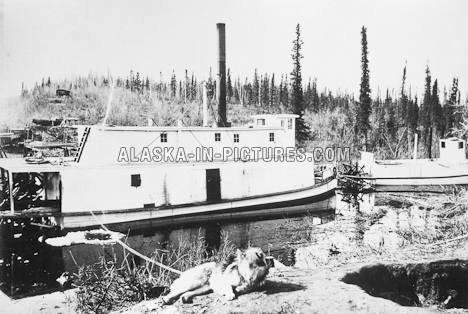
Oceans and rivers were the first mode of transportation and means for getting people and supplies into and around Alaska. Alaska Natives were using the river system long before the Russians or Americans arrived. The challenges with this mode of transportation was that it was limited due to weather conditions as to the amount of goods that could be transported. During the summer months, steamboats, canoes,and ships could access the open waters, however during the harsh winter months, the rivers turned into trails for dogsleds which slowed things down considerably.
Steamship - Alaska in Pictures

After America purchased Alaska, things started to move along more rapidly than when the Russians were here. As more people came to Alaska, especially in the advent of the Klondike Goldrush, roads and railroads started being built. Access to Alaska through the waterways limited access. After gold was discovered in the Interior of Alaska, an interest rose to access more areas of Alaska. The military has been a monumental part of road and railroad development in Alaska. This was due to the need to protect our homeland. Many challenges have risen in the development of both roads and railroads, but as one milestone is reached, plans for more roads to connect Alaska are in the making.

Alaska Railroad - Alaska in Pictures

Because economic barriers stall the building of roads and railroads, people like Carl Ben Eilsen took on the challenge of bring aviation to Alaska. Bless his heart! Aviation connected Alaskan communities to each other. The size of Alaska seemed to lesson with this mode of transportation. Communities could now communicate more efficiently with each other via airmail. Remote villages could receive supplies more often.
Float Plane - Alaska in Pictures


As technology advance in the world of aviation and the Space Age, this brought modern telecommunications to the state of Alaska. This allows for students in remote villages to receive equitable education opportunities through long distance learning opportunities, businesses can conduct meetings without the expense of flying in for a meeting, medical facilities can communicate with remote villages for medical care.
Satellites - Alaska in Pictures

Examine:

What were the factors that prompted the growth of communication systems in Alaska?

One of the main factors that prompted the growth of communication systems in Alaska was that travel had been and still can be very difficult. Weather conditions change on a dime and have cost lives whether traveling by road, rail, waterways, or air. Modern communication systems provides instantaneous communication. I love being able to communicate with my brother in Petersburg,AK regardless if he is fogged in or not. My brother has two daughters attending UAF in Fairbanks. There have been times when I have been notified by my brother about a situation I needed to help out with my nieces. All he had to do was text me.

Another factor that prompted the growth off communication systems was the need for Alaskans to be connected with the rest of the world. Starting with mail, to the telegraph, to the telephone, to satellite systems which opened access to the world through television and the internet, these modes of communication have provided Alaskan's opportunities to be competitive in our global economy.

Another factor that prompted growth of communication systems was the need to protect our homeland. Before the telegraph was brought in by the military, it would take a year for correspondence from Alaska to reach Washington, D.C. Wow! How vulnerable that must have made us.

Extend:

How adequate are the systems in your region of the state? Fairbanks has the advantage of a quality college university. Communications systems are well developed and studied here.

How does this affect the people in your area and their ability to make a living?The communication systems enhance the lives of people in Fairbanks. Skyping is a common mode of communication with more remote villages for meetings and services.

What does this mean for the economy of Alaska? Communication and the ability to network is a way of sustaining communities. We need to be able to understand each others needs in order to help support each other.

Evaluation:

Because of the challenges that living in Alaska poses in all sectors of life up here, this drives people to continue to make improvements in transportation and communication. Exploration continues for new ways to access the plethora of resources that Alaska offers. One of my aha moments in the Module was that Norway has the icebreakers needed to continue with off-shore drilling. I am making an assumption here, but if Norway is able to make advancements like this, what is wrong with us? It frightens me a little to watch our great nation lagging behind other nations. I want to be able to say we are a leader in our world.

Thursday, March 15, 2012

Module V

RESOURCES GALORE!

Essential Questions:

What have been the major components of the Alaska economy during the American period of 1867-present?

The major components of the Alaska economy during the American period of 1867 - present have been:


Oil- The oil and gas industry is the largest component of Alaska’s economy,(AK DCED ECONOMY). Nearly 85 percent of the state budget is supplied by oil revenues.

Tourism-Tourism is also a major sector of Alaska’s economy attracting over 1.1 million visitors annually. The tourism industry is Alaska’s second largest primary employer,(AK DCED ECONOMY). Fairbanks swarms with tourists during the summer months. Cruise buses line the streets as they take tourists to local attractions in the community.

Fishing-The rich fishing waters off Alaska’s coast make it one of the world’s finest sources for wild seafood. Each year nearly 6 billion pounds of seafood are harvested. Alaska is the number one producer of wild salmon in the world and has the only salmon industry certified as "sustainable" by the Marine Stewardship Council,(AK DCED ECONOMY). Folks from Fairbanks have to travel to good salmon fishing spots.


Examine:

What were the main reasons for the American purchase of Alaska?

According to Alaska's Heritage, newspapers of the time gave four reasons why the United States bought Alaska. These were: (1) to maintain Russia's friendship (England's government had been sympathetic to the Confederacy during the recent American Civil War, France had sent troops and set up a dictator in Mexico during the same war, and Russia was a potential ally against either country). Russia has stepped in more than once to come to the aid of Alaskans. The big news this year was Russia's assistance in delivering fuel to the community of Nome, AK. It is always good business to never "burn your bridges."

Another reason America purchased Alaska was to facilitate acquisition of British Columbia. A third reason was to derive economic benefit from Alaska's resources. Alaska has a bust or boom economy. This has been the pattern as people who have come to Alaska go for the gold, fish, oil, whales, or furs until they are dangerously depleted, back off, then find something else of great value to extract. History seems to be repeating itself, you would think we would learn from past mistakes. Alaska citizens love their great land they live in and a steady awareness of the harmfulness that a bust or boom economy can create is helping us to consider pros and cons of more mining or drilling before it happens. The fourth reason America had for purchasing Alaska was to move closer to the markets of Asia. Alaska has provided the United States great positioning in the world to enable them to access different opportunities for trade worldwide.


Evaluate:

I am learning so much about this wonderful state I have chosen to reside in. This Module is packed with great information that gives me a clear picture of how Alaska has evolved to where we are now. Next module, I am going to give pictures and links a shot. I think I have the breaks in the paragraphs down.

Sunday, March 4, 2012

Russian America

Well here goes another try at blogging. I want to thank Brenda Rosenthal for helping me discover that my problems with making my blog reader friendly may be due to computer problems. I don't feel quite so inept at this. Module IV Essential Question: What was the nature of cultural contact between the Europeans of Russian America and the Natives of Alaska? The nature of cultural contact between the Europeans of Russian America and the Natives of Alaska was similar to the Europeans settling the thirteen colonies on the east coast and their contact with Native Americans. Exploitation was the name of the game. The Europeans saw the Alaska Natives as uncivilized savages who were to be civilized or conquered. The Europeans did not have the Alaska Natives best interest in mind. They came to collect the goods, make a profit and leave. Alaska Natives were put into inferior roles by the Europeans. A legal system was put into place to strip Native's ownership of their traditional lands. Despite the strong efforts of the Europeans and Americans to destroy and diminish the Alaska Native culture, they fought, persevered, and survived to horrific treatment they received. As I mentioned earlier in a previous blog, the one difference I noticed about the Alaska Native culture is their steadfastness in holding to their traditions and the pride they take in that. They are a hardy people and a culture to be revered and respected. Examine: What other nations demonstrated an interest in Alaska - Why? The other nations that demonstrated an interest in Alaska were England, France, Spain, Portugal, and America. European nations were in competition with each other for world resources. Their attention was drawn to Alaska when they heard of the Russian's setting up hunting camps in the Alaskan Pennisula. Spain soon discovered that they were overextended in their efforts to compete for resources in Alaska and settled for the California area. The English explorer, Captain James Cook voyaged clear to the Arctic waters. The result of this was that people finally knew the shape of North America. Captain Cook assumed the Alaska Natives wanted the changes imposed by the English. The story of Captain James Cook ends tragically when he was killed during a last stop in Hawaii by Hawaii Islanders. The effect America had on Alaska is evident today as Alaska is our 49th state of the union. America purchased Alaska in 1867 as a territory. The Russians saw the United States as the only potential buyer. At this time, Russia and the United States were drawn together by a common hostility towards Great Britain. One of the most interesting facts I learned in this unit was that of all the European powers, Russia was the one supporter of the Union in the American Civil War. Evaluate: I enjoyed this unit. The one thing I am frustrated with is my inability to make my blogs more reader friendly, I apologize for that. I will keep exploring and trying different things to improve my presentation.

Sunday, February 26, 2012

Culture, Culture Everywhere!

Module III Essential Question: Is there an "Alaskan" culture? How could it be described? There definitely is an Alaskan culture. I would not have understood this if I had never lived here.I am just beginning to understand parts of the culture in the area in and around Fairbanks. I have learned about the culture around Fairbanks from touring the Museum of Alaska at the University of Fairbanks and the Morris Thompson Cultural Center. Meeting Athabascan Natives has also been a way to learn about a part of Alaskan culture. I would describe the "Alaskan" culture as that of the northern people who are survivors holding true to their traditions and culture. The people here are hardy due to the weather conditions. Their priorities are more focused on survival. It is refreshing that a fur coat is not something to be ashamed of but something that is valued as a tool to keep one warm in the frigid temperatures. After reviewing the information in this module and reading James Michener's, Alaska, it is evident that Alaska natives have been exploited by other cultures over and over again. They now stand up for what is theirs with a strong voice through the Alaska Federation of Natives. Examine: What is your concept of culture? My concept of culture is how one grows up. Culture is your environment from family,traditions,geographical location, ancestory, political views, to values and beliefs. Culture is all encompassing. It is very easy to judge a group of people by looking from the outside. As addressed in this module, it is important to delve deep into a group's culture before making judgements of any kind. I am learning to respect the "Alaskan" culture with every new adventure that comes my way. Evaluate: Once again, this module is taking me to a deeper level of understanding the Alaska Native culture. The one common theme I noticed between all the Native tribes is sharing what they have with their group. This is so uncommon in my independent western culture. I do not completely understand this part of the Alaska Native culture.

Sunday, February 19, 2012

Awareness through Adventure

Module II Essential Questions: How does knowledge of natural systems relate to the roles of educators? The roles of educators are to facilitate learning and build life long learners in their students. Knowledge is power. When students become aware of their surroundings and the world they live in and that they are an active part of it, they become more responsible and make educated decisions concerning their carbon foot print. Educators have the best opportunity to make lasting impressions on the students they teach and mentor. An Elementary teacher could engage students in a recycling project. Many Elementary students in Fairbanks have the opportunity to participate in a gardening program at their schools.,http://www.calypsofarm.org/default.html. High School and College educators have many opportunities to bring awareness of natural systems to their captivated audience of young minds. We all contribute to the wellness or the destruction of our world we live in. Our Earth is fragile and it is only a matter of time until the damage that is being done becomes irreversible. Examine: How does permafrost changes affect topography? One of the first things that people told me after moving to Fairbanks was: "Don't buy a house that is built on permafrost." They pointed out a few homes and what the results are over many years of the thawing and freezing permafrost does to a home. I have heard stories of homes literally falling apart due to the constant shifting of the ground. Chena Hot Springs Road that goes to Chena Hot Springs is uneven with many heaves due to permafrost. Fairbanks has many bike trails in the area. The bike trails are also uneven in many areas which is due the terrain and some permafrost activity. Black spruce trees grow on areas of permafrost. They are stunted and sparse. Another place where permafrost is evident in the Fairbanks area is at Creamer's Field. A walking trail is built through the Boreal Forrest. The link provided explains the changes that occur in topography due to permafrost. http://alaska.fws.gov/fire/role/unit1/background.cfm. Hope you enjoyed the mini tour guide of Fairbanks. Evaluation: I enjoyed this Module. The diverse ways of content delivery kept me engaged. I especially enjoyed the Teacher's Domain video clips. What a useful teaching tool. I should have taken this class early when I first come up to help me understand where is the world is Alaska. We are all connected and all of our actions affect everyone on the planet. Perhaps through this class, we can all become more responsible in our efforts to decrease our carbon foot print. It may seem overwhelming when we talk about climate change and how huge it is, but if we each do our part, that is powerful and huge as well.